


Description
Zagora, a Historic Village
Today, Zagora is the most populous village of Pelion. It has 3,000 inhabitants and is built amphitheatrically on its northeastern slopes, at an altitude of approximately 450–550 meters. One can reach it by road from Volos via Portaria–Chania, covering 47 km, while the distance via Tsagarada is about 80 km.
The village preserves its original division into four districts: Agia Paraskevi (Perachora), Agia Kyriaki, Agios Georgios, and the Transfiguration of the Savior. All, except for the last, have squares, with the central and largest being that of Agios Georgios.
Its economy is based mainly on apple cultivation. Nearly the entire production is collected and marketed by the Zagora Cooperative, one of the first cooperatives in Greece. Founded in 1916, it played a major role in the economy of both Zagora and the wider region. As the first apple export body in the country and designated a model cooperative since 1982, it now has over 750 members and is fully organized with computerized systems, its own cold storage facilities, sorting lines, and transportation means. In recent years, its activities have extended into tourism as well, with a fully equipped restaurant, café, and supermarket in Zagora’s seaside port, Horefto.
Zagora hosts many public services, effectively making it the administrative center of Eastern Pelion. Specifically, it has a fully equipped junior and senior high school, a unified six-grade primary school, two kindergartens, a fully equipped Health Center serving the entire region up to Tsagarada, an O.T.E. (telecommunications office), a D.E.I. power station, ELTA post office, and a police station.
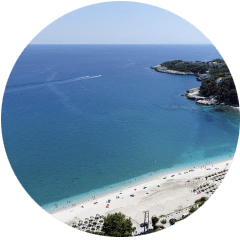
Descending 7 km from Zagora, one reaches its port, Horefto, which has the longest beach among the seaside villages (2 km). There are numerous hotels, campsites, restaurants, shops, and entertainment venues capable of serving a large number of visitors.
Near Zagora, approximately 7 km to the north, lies Pouri, a very picturesque village with a large three-level stepped square and the most beautiful view of the Aegean.
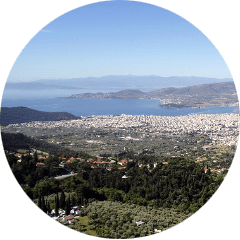
The two regional roads that form the so-called “Pelion loop” meet here and lead us to Zagora, the largest and most historic village of Eastern Pelion. Spread across the lush and sunny slope, divided into its four large districts (Agia Paraskevi or Perachora, Agia Kyriaki, Agios Georgios, Sotira), it appears to the visitor seeing it from afar like a cluster of four distinct villages.
The name “Zagora” is likely of Slavic origin and means “the place behind the mountain.” For this reason, the villages lying behind Pelion were once called “the villages of Zagora,” and Pelion itself was at one time known as “the mountain of Zagora.” As for Zagora itself, it was formerly known as Sotira, named after the post-Byzantine Monastery of the Transfiguration of the Savior, on whose site now stands the parish church of the district bearing the same name.
The village was settled in its present location during the period of Ottoman rule, likely by inhabitants of an older settlement that existed at the site of Paliokastro, about 3 km northeast of the center of today’s Zagora, where several building remains have been found. Zagora grew further with the arrival of refugees and fugitives from all over the lands enslaved by the Turks.
Although considered a “hasi” (tax-exempt estate) in those years, Zagora had enviable handicraft and commercial-shipping activity from the mid-18th century onward, especially in the production and trade of silk and woolens, in which it held first place in Pelion. Zagorian merchant-shipowners transported them with the famous “Zagorian ships” to all the known ports of the Mediterranean and the Black Sea.
After the Pelion uprising, the Zagorians—accustomed from earlier times to “journeying to foreign lands,” as the Dimtrieis note—discovered, led by the brothers Alexandros and Dimitrios Kassavetis, the “gold-bearing veins” of the Nile country, Egypt, bringing thousands of fellow Pelionites along with them. Their success in the wealthy countries abroad, especially in Egypt, had a profoundly positive impact not only on the economy but also on the intellectual, cultural, and social life of Zagora. Thanks to the benefactions of its distinguished sons, the village gained many public works, including the first “schools of common letters” in Pelion and the higher-education “Hellenomouseion,” which became the first spiritual center of nationwide influence in the wider Pelion region and where many great figures of modern Hellenism studied, among them Rigas Velestinlis. Zagora was also enriched with many churches, large squares, beautiful mansions, aqueducts, roads, fountains, and numerous other public works that culturally uplifted the town.
Among the many benefactors of Zagora—each contributing in his own way—are Ioannis Prigos, who, together with Nikolaos Zagoras, erected in 1777 the new building of the “Hellenomouseion” and endowed it and its library; the brothers Moses and Nikolaos Kritsis, who supported educational efforts in numerous ways and whose bequest still funds scholarships for Zagorian secondary students and university students; the brothers Efstathios and Georgios Lapatés, who contributed to the operation of the “Hellenomouseion,” enriched its library, and funded the unique wood-carved iconostasis of the Church of Agios Georgios; Ioannis D. Kassavetis, who founded and endowed the Girls’ School of Zagora; the brothers Herakles and Alexandros Voltou, who, among other national donations, generously supported their hometown by constructing the aqueduct of Sotira, the iconostasis of the parish church, and dowries for many impoverished girls; Kimon Pantazopoulos, who left half his fortune to the community of Zagora (and the other half to Smyrna) to fund scholarships in education science and who also built the newer building of the Zagorian Library; Euphrosyne D. Kassaveti, who funded the construction of the Horefto–Zagora–Portaria cobblestone path (the longest in Pelion), the restoration of the Zagora aqueduct, and the neoclassical fountain in the square of Agios Georgios; Dimitrios Polymeris, the greatest benefactor of Pelion, who donated his vast wealth to Zagora for operation of a high school and hospital, construction of an aqueduct, and scholarships for postgraduate studies of Pelionites. He also provided approximately 250,000 sterling pounds for the construction of the Zagora–Portaria road and funded the National Road Fund with 100,000 pounds so that the other Pelion villages could be connected to Volos by road. Among later benefactors are Alexandros Pantos, founder of the Panteion School of Political Sciences, and Georgios Koletzos, who left an endowment for university studies.
In our account of the great figures of Zagora, we must not omit other distinguished personalities who elevated and were themselves shaped by their homeland. In the religious sphere: the neo-martyr Triantafyllos, Ecumenical Patriarch Kallinikos III, Patriarch of Jerusalem Prokopios, Metropolitan of Dimitriada Gregorios, and possibly Metropolitan of Seleukeia Dothiseos. In letters: Philippos Ioannou, the teachers Konstantinos Logiotatos, Nikolaos Kassavetis, and Nikolaos Kapetanakis; the thinker, poet, and essayist Dimitrios Kapetanakis; the historian Giannis Kordatos; the poet Petros Magni (Konstantinos Konstantinidis); and the author and researcher Pilio Zagra (Apostolos Konstantinidis). In science: Nikolaos Kosti, personal physician to King Otto; Theodoros Afentoulis, professor of pharmacology; and Ioannis Panto, doctor and MP of Magnesia. In the national struggles: the Basdekaios, captains in the Pelion uprisings (though originally from Makrinitsa), Hieronymos Kassavetis, president of the Provisional Government of Pelion during the 1878 revolution, and fighters Antonis Stefos, Athanasios Samsarelos, Apostolos Fronimos, among others.
Monuments and evidence of this flourishing period supported by Zagora’s worthy benefactors include its large, well-built mansions, its 38 churches, and its other monumental buildings. Greatest among them is the “Hellenomouseion,” of which one building survives near the beginning of the road to Horefto—likely the old school’s boarding house. Equally important is the wealth of relics preserved today in the modern Public Library of Zagora (behind the Church of Agios Georgios). These include 1,200 early printed books, codices, and manuscripts of the old Zagorian Library—donations of Patriarch Kallinikos III, Ioannis Prigos, and the Lapatés and Voltou brothers—along with another 13,500 books donated in later years by various families and benefactors.
However, the greatest monumental and devotional wealth is found in the churches and monasteries of Zagora. Notable among them are the three of the four parish churches— all three-aisled basilicas with stone-tiled gabled roofs:
Agia Kyriaki (1740): in the square of the district of the same name, three-aisled, with a splendid interior and a magnificent gilded wood-carved iconostasis (1742), the work of the craftsmen Loizos, Kyprios, and Panagiotis from Galatas.
Agios Georgios (1765): built by initiative of Patriarch Kallinikos III next to the square of the same name, with one of the finest wood-carved iconostases in Pelion (1774), an outstanding example of Neo-Hellenic baroque, along with an impressive bishop’s throne, pulpit, and masterful stone reliefs arranged in three horizontal exterior bands behind the sanctuary.
Agia Paraskevi (1803): in Perachora, the work of folk architect Dimos Zipaniotis, with stone reliefs and inscriptions by Miliou and a finely crafted gilded iconostasis (1810).
Among Zagora’s other ecclesiastical monuments (excluding those of Horefto), the remote monasteries of Panagia Rasova—its original structure dating to the 13th century—and the Taxiarchs, with a masterpiece wood-carved iconostasis by the Cretan Komnenakis, stand out. So do the ancient chapels of Prophet Elias in Perachora (1614), the oldest structure after the Rasova Monastery, Athon or “Athanas,” above the town, and the chapels of Agios Dimitrios and Agios Athanasios (1639) near Paliokastro, all adorned with fine 17th-century iconostases.
Several of Zagora’s fountains are also monumental, the most notable being the stone-ornamented “Fountain of the Kralis” at the upper end of the Agios Georgios district, said by tradition to have been built by a Serbian ruler (kralis) but in fact constructed by the Zagorian armatolos Mitros Basdekis in 1828.
Also of interest are the “Fountain of the Despot” in Sotira, built in 1765 by Patriarch Kallinikos, and the neoclassical marble fountain with dolphins, a work of Euphrosyne Kassaveti, in the square of Agios Georgios.
Yet Zagora has not only a glorious past but also a dynamic present. Seat of the municipality since 1999, it has a modern economy based primarily on the production and marketing—through its Agricultural Cooperative—of the renowned “Zagorin” apples of the Delicious variety, which have conquered foreign markets. It also performs notably in agritourism, with the women’s cooperative producing, packaging, and marketing traditional sweets, foods, drinks, dried herbs, and cosmetics. In the broader tourism sector, Zagora continues to grow with numerous guesthouses, rented rooms, taverns, and more.
Location

Video
Advert details
Entire Houses to stay


 Step to Paradise House
 Villa Katerina - Tsagarada
 House of the Rising Sun | Agioi Saranda Pelion
 Duchess Eva's Seafront Guesthouse
 Iasona's Pelion House


 4 Diamonds
  Villa Maria Amalia
  Centaure Inn Villa - Pelion


Εnchanting exotics beaches
Holidays by and near the sea
Escapes to villages of Pelion







Zagorin - Agricultural Cooperative

CONTACT INFORMATION
Information about Pelio
Pelio, Magnesia, Thessaly, Greece
ΤΗΛ. ++306947819381
FREELINKS
ATM MACHINES
Zagora
Agios Ioannis
Tsagarada
Portaria
Volos
Useful Phone Numbers
Volos Hospital-24213-51000
Volos Fire Service-24210-76850
Zagora Health Center-24260-22222
Kissos Regional Clinic-2426031210
Tsagarada Regional Clinic-2426049208
Portaria Regional Clinic-2421099106
Police Volos-24210-76995
Zagora Police-2426022529